
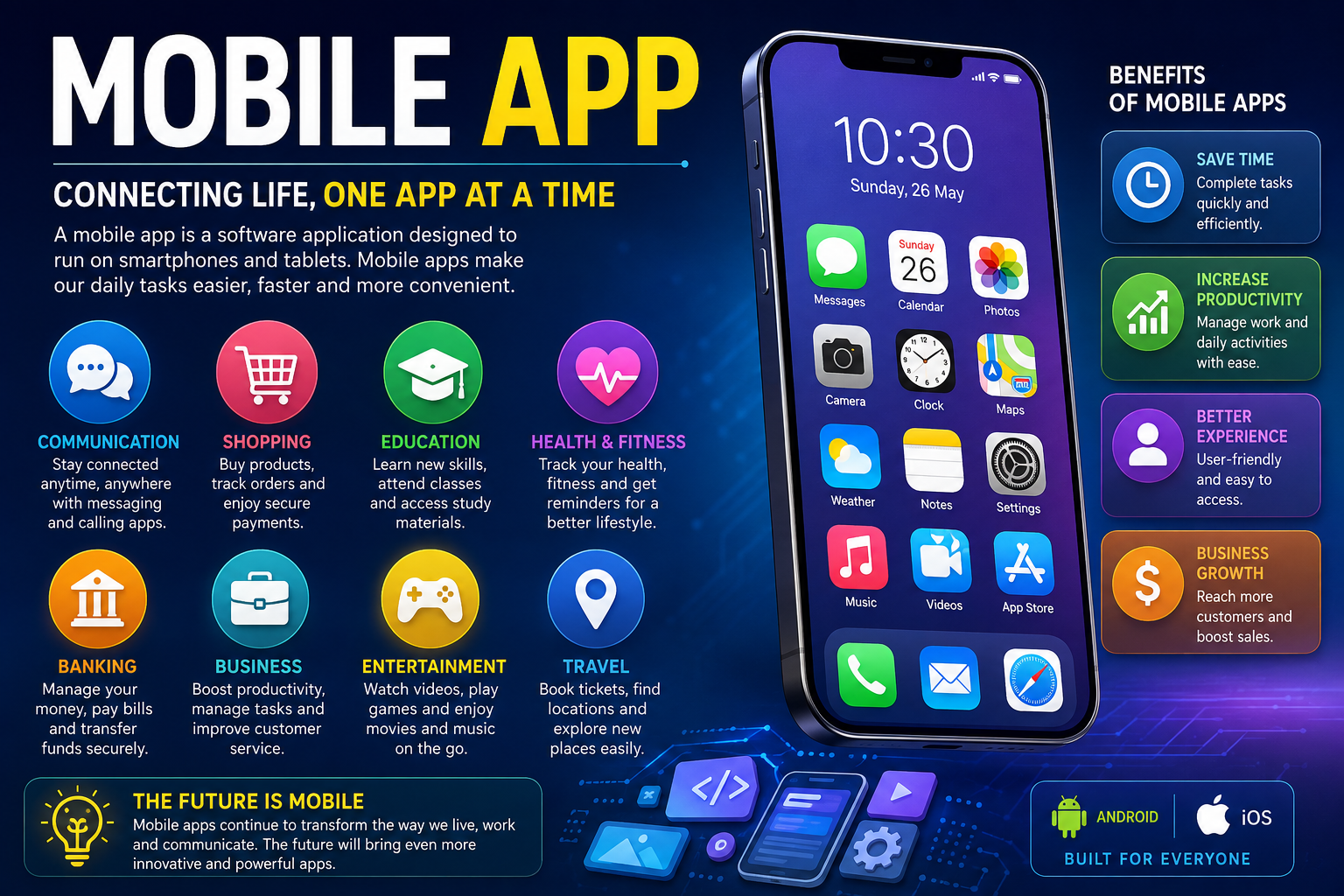
Mobile App
A mobile app, short for mobile application, is a software program designed to run on smartphones and tablets. Mobile apps have become an essential part of modern life because they make many everyday activities faster, easier, and more convenient. From communication and entertainment to education, shopping, banking, and business, mobile applications are now used by millions of people around the world.
Mobile apps are mainly developed for operating systems such as Android and iOS. Android apps are commonly distributed through the Google Play Store, while iOS apps are available through the Apple App Store. Developers use different programming languages and development frameworks to create these applications. Popular technologies include Java, Kotlin, Swift, Flutter, and React Native.
There are many different types of mobile applications. Communication apps allow people to send messages, make voice and video calls, and share files. Social media apps help users connect with friends, share photos and videos, and interact with online communities. E-commerce apps allow customers to browse products, place orders, make payments, and track deliveries directly from their smartphones.
Mobile apps are also transforming the education sector. Students can use educational apps to attend online classes, watch lessons, practice quizzes, learn languages, and access digital books. Teachers can use mobile applications to communicate with students and manage educational activities.
In the healthcare industry, mobile apps can help users track fitness activities, monitor appointments, receive health-related information, and communicate with healthcare providers. Similarly, banking and financial apps allow users to check balances, transfer money, pay bills, and manage their finances without visiting a physical branch.
Businesses can benefit greatly from mobile applications. A customized business app can help companies communicate with customers, promote products, manage orders, provide customer support, and increase sales. Mobile apps can also improve brand visibility because customers can access a company’s services directly from their smartphones.
Developing a successful mobile app requires careful planning. First, developers need to identify the target audience and determine what problem the application will solve. Next, they design the user interface and user experience. After that, developers build the application, test its features, fix errors, and optimize its performance. Finally, the app can be published on the appropriate app store.
Security is another important aspect of mobile app development. Applications that handle personal information, passwords, financial data, or payment details should use appropriate security measures. Developers should also regularly update their apps to fix security vulnerabilities and improve performance.
Mobile applications can also create opportunities for entrepreneurs and freelancers. Businesses can earn money through app sales, subscriptions, advertising, in-app purchases, or product and service sales. With the growing use of smartphones, demand for useful and innovative mobile apps continues to increase.
In conclusion, mobile apps have become an important part of the digital world. They provide convenient solutions for communication, education, shopping, banking, entertainment, healthcare, and business. As smartphone technology continues to develop, mobile applications are expected to become even more powerful and useful, creating new opportunities for users, businesses, and developers.